|
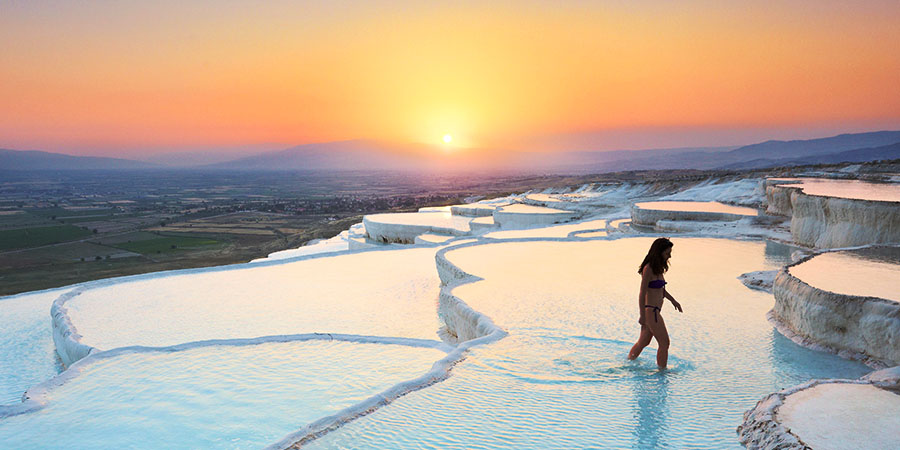
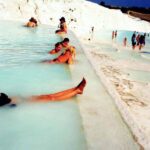
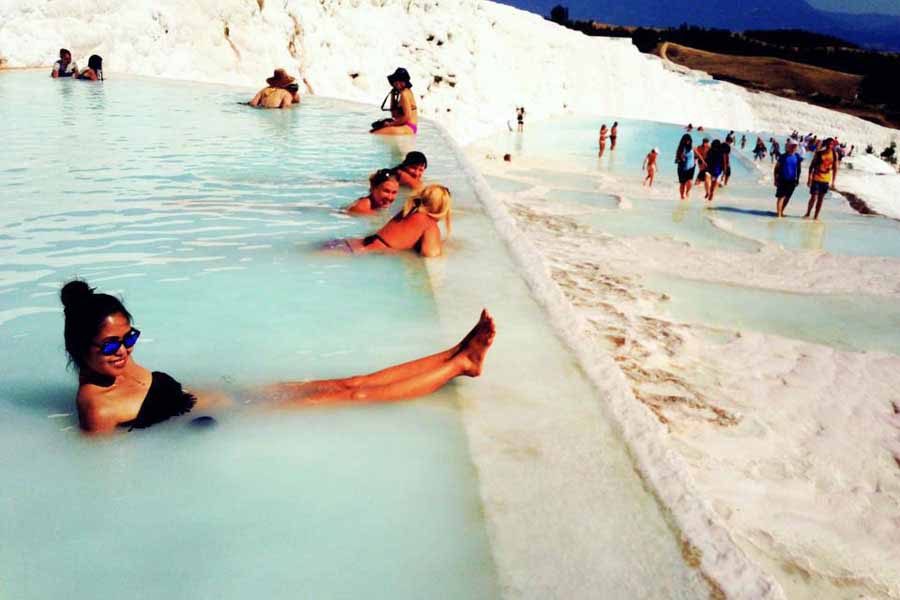
Next along is Dalyan, home of the much-photographed rock tombs and famous mud baths. The protected Iztuzu beach is a nesting ground to the endangered caretta caretta turtle and development here is strictly controlled.
Visitors to Fethiye too can marvel at Lycian Rock Tombs, the most impressive of which is the Tomb of King Amintas which overlooks this pretty harbour town. Ölü Deniz is without a doubt the most famous of the beaches in the area, with it s stunning blue lagoon and the nearby resorts of Hisarönü and Ovacık cater specifically for tourists with a wide range of accommodation and choice of shops, restaurants and bars.
| THE MEDITERRANEAN REGION |
|
|
The southern coast of Turkey, or the Turkish Riviera as it is now known, boasts long stretches of sandy beach, world-class golf courses and the biggest concentration of 5 star hotels and holiday villages in the Country. The Mediterranean region stretches from beautiful Patara, birth place of St. Nicholas and home to an award-winning 17km beach, all the way along to Antakya (or Hatay) where there is a world-renowned archaeology museum.
The Region has a wealth of historic sites including the mountain cities of Termessos and Arikand, as well as coastal towns such as Olympos, Kale, Kekova and Kaş. The ancient cities of Perge, Aspendos and Side are located on the coastal plain east of Antalya, known in antiquity as Pamphylia. St Nicholas was not the only famous person to hail from this part of the world as according to early sources, Saint Paul was born in Tarsus. |
|
|
|
|
| |
|
|
|
Antalya is one of the Mediterraneans most important cities and a popular holiday spot in its own right, with the districts of Konyaaltı and Lara to west and east respectively, both popular beach resorts. An attractive marina and palm-lined streets lend a cosmopolitan atmosphere to the city, alongside excellent restaurants and lively night-life. The 38 metre high Yivli Minaret, erected in the 13th century, has become a symbol of the City. The Minaret is situated on the outskirts of the district of Kaleiçi, the historic quarter of Antalya. Kaleiçi is characterised by its narrow streets lined with quaint little shops, restored traditional houses and boutique hotels.
Immediately to the west of Antalya lies the beach resort of Kemer, surrounded by pine forests and mountains. Next are the peaceful havens of Olympos and Çıralı, perfect for those looking to escape the crowds. The neighbouring resorts of Kalkan and Kaş, whilst increasing in popularity, have managed to retain much of their picturesque charm.
Heading in an eastward direction about half an hour away from Antalya is Belek, Turkey s premier golf resort. A little further along is the bustling resort of Side which in addition to the obligatory golden sandy beaches is famed for its sunsets over the Temple of Apollo and a sizeable Hellenistic ancient theatre. |
|
|
|
|
| |
|
|
|
The next big town east of Antalya is Alanya, a panoramic port city on the southern slopes of the Taurus Mountains surrounded by orange, lemon and banana groves. Used by the Selçuk Sultan, Alaaddin Keykubat as a winter residence, Alanya has a shipyard from the Selcuk period, a 9th century castle as well as a choice of beaches at which to enjoy an array of watersports or simply relax and soak up the sun.
Mersin is a major commercial centre and home to a significant shipping port. Ferries depart regularly from here, bound for the Turkish Republic of Northern Cyprus. East of Tarsus, the Çukurova plain is a fertile agricultural region known especially for raising cotton. In the middle of this plain is found the city of Adana, a rich city with a large textile industry. East of this region is the Dörtyol (Issos) Plain where Alexander the Great defeated the Persian king Darius. As a result of his victory, a port city bearing his name was established and thus we have modern day Iskenderun.
Leaving Iskenderun to the southeast, the road goes through the Belen Pass to Antakya (Antioch). This first Christian community founded by Saint Peter has given Antakya a special religious significance. The first sermons were preached in a cave outside the city. It is visited today by many as a site of pilgrimage. Worthy of an inland detour is Kahramanmaraş, the home of Turkish ice cream.
| EASTERN AND SOUTHEASTERN ANATOLIA |
|
|
|
With its high mountain ranges, plateaus, plains and lakes, its creek and river beds splashed with hues of purple, brown, gray, yellow and red, and some of the best Turkish architecture anywhere, this region of Anatolia is like a historical documentary on ancient life. Sivas, Divrigi, Erzurum, Battalgazi, Harput, and Ahlat, all cities situated in this region, were important centers of Selçuk art. |
In Eastern Anatolia are the cities of Agri, Bingöl, Bitlis, Elazig, Erzincan, Erzurum, Hakkari, Kars, Malatya, Mus, Tunceli, Van, Ardahan and Igdir, while in Southeastern Anatolia the larger cities are Adiyaman, Diyarbakir, Gaziantep, Mardin, Siirt, Sanliurfa, Batman, Sirnak and Kilis.
Erzurum is located on a large plain at an altitude of 1950 meters. In the city, there are many religious schools, tombs and mosques from both the Selçuk and Ottoman period which are well-worth seeing. The city of Kars in the northeast is famous for its castle and nearby Ocakli (Ani) is a historical city with rich architecture from the 10th and 11th centuries.
|
|
|
|
Mount Ararat (Agri Dagi), whose peak soars up 5165 meters is important for a number of different faiths. It is believed that after the Flood, in which all humanity was destroyed, the ark of Noah came to rest on Mount Ararat and as the waters receded Noah and his family settled on the nearby Plain of Igdir. |
As their numbers increased, they eventually spread along the Tigris and Euphrates rivers to other parts of Anatolia. Accordingly, Igdir is seen as the center from which the second generation of humanity multiplied and again spread over the world. The magnificent palace complex of Ishak Pasa, which looks down upon Dogubeyazit, was built in the later part of the 17th century by the Ottoman governor, Ishak Pasa. The site of the castle is superb and it is made up of a kitchen unit, a mosque and separate womens and mens quarters.
|
|
|
|
Lake Van is Anatolias beauty center. In order to see all of this beauty, it is absolutely essential that a tour of the entire lake be made, during which time the beautiful mountain silhouettes, bays, beaches, islands and important Turkish cultural and art centers may be seen. The city of Van, which lies on the southeastern shores of the lake, was the capital city of the Urartu empire. The Van Castle, which was built by the Urartus around 1000 BC, is a dynamic example of the age in which it was built and is definitely worth seeing. |
South of Van, the city of Edremit is a poplar vacation getaway famous for its beaches, camping spots and restaurants. On the island of Akdamar is located the Akdamar Museum, which was originally a 10th century church.
As the Tigris and Euphrates flow towards the plains of Mesopotamia, they pass through an important region of Anatolia. Some of the bigger cities in this region are Diyarbakir, Mardin, Adiyaman, Sanli Urfa and Gazi Antep. The region is the oldest cultural settlement center in Anatolia. North of Diyarbakir is Cayonu, the most important neolithic settlement of the area. The basalt walls of Diyarbakir, which are more than 5 kilometers in length, have the distinction of being the longest city walls in the country. Mardin is one of the few cities in the country which has actually preserved its traditional aesthetic architecture. It is a unique site not only because of its well-maintained state but also because of its unusual location on top of a hill.
The prophet Abraham, who is the father of 3 different faiths, is believed to have lived in Sanli Urfa and Harran and so they are considered holy places. The Ataturk Dam, built in the town of Bozova near Sanli Urfa is the biggest in Turkey and 4th largest in the world. The lake is surrounded with beautiful scenic sites. The Plain of Harran with its vast farmland will be the most productive agricultural region of the country. Gazi Antep is the most important industrial and agricultural area in southeastern Anatolia. We doubt that any visitor who has come all the way to Gazi Antep will leave without first having tasted the famous local varieties of kebap, lahmacun and baklava or without buying a few packages of Antep pistachios for friends and relatives
|
|
|
|
To the northeast of Adiyaman, on top of Mount Nemrut (Nemrut Dagi) is the mausoleum made for the Commagene King, Antiochus I. On the east and west of the memorial grave site are ritual terraces and on these terraces are gigantic statues of the gods. The best time to see Mount Nemrut is at sunset. |
Malatya is an important industrial and agricultural region on the lower Euphrates. It is famous for its apricots and the 13th century Ulu Cami mosque in Battalgazi with its beautiful glazed tiles.
| THE BLACK SEA REGION |
|
|
|
|
Beaches that seem to go on forever, mountains covered with verdant green and picturesque valley and plains. Fields of tea, hazelnuts, tobacco and corn. The winding blacktop road following the near strip of beach bounded by steep mountains falling, it would seem, straight into the sea. Bays, fishing villages and beaches. This is the Black Sea region. The following cities are all located in the Black Sea region: Amasya, Artvin, Bolu, Çorum, Düzce, Giresun, Gümüshane, Kastamonu, Ordu, Rize, Samsun, Sinop, Tokat, Trabzon Zonguldak, Bartin and Karabük. |
| |
|
|
|
|
|
You can begin your trip in this charming luxuriantly green little region of ours from the endless hazelnut orchards and foaming sea of Akcakoca. Let us not neglect, however, to mention the industrial cities of Eregli, Zonguldak, Karabuk and two cities of the interior one, Safranbolu, which is full of examples of Turkish architecture of unrivaled beauty, the other city being Devek, famous for its intricately carved walking canes. |
Along the coast you will come to the delightful recreational sites such as Inkum, Amasra and Cakraz. As you pass through Cide and Inebolu and approach Sinop, you might begin to wonder if there are still traces of the Amazons in the forests. As far as can be determined from mythological evidence the women warriors called Amazons lived in the region. The name of Sinop, one of the countrys province, comes from a queen of the Amazons named Sinope. The birthplace of the philosopher Diyojen, this city, with its natural bays protected from the winds, is one of the Black Sea`s best holiday spots. |
|
|
|
Samsun is one of the Black Sea`s biggest ports and is a industrial and commercial center. The first rays of light that would eventually lead to the birth of the Turkish Republic broke through the darkness here. The characteristic feature of the coast between Samsun and Trabzon are the extensive hazelnut orchards. |
The cities of Unye and Fatsa east of Samsun are popular holiday resorts with natural scenic beauty, beaches, accommodations, camping and restaurants. Ordu is a charming Black Sea city with hazelnut orchards stretching out for miles in every direction. The Castle of Giresun, perched upon a steep rocky slope, is like a crown upon the city. From the castle, the beaches of Giresun, stretching out like cords of gold are unforgettable. The Roman general Lucullus saw cherries for the first time in Giresun and liked them so much we had them introduced into Europe. |
|
|
|
Another important commercial port on the Black Sea is Trabzon. As the beginning of Irans transit road, it connects with the ports of the other countries on the shores of the Black Sea. The Trabzon Castle was founded on an area shaped like a table and the architecture which has grown up around the castle reflects Byzantine, Commagene and Ottoman styles. |
The most important structure in Trabzon is the Ayasofya Museum. The interior is decorated with frescoes and on the exterior are a number of reliefs. The panoramic birds-eye view of the city which can be had from Boztepe Park and the Ataturk Mansion are splendid indeed. Near Macka inside the Altindere National Park is the Sumela Monastery. The Sumela Monastery, which is perched on high cliffs overlooking the Altindere valley, was founded in the 14th century by Alexius III. Inside the monastery is a church, a library, various other rooms and a sacred spring. |
|
|
|
The area around Rize is the part of the country which receives the most precipitation. In this region where every conceivable hue of green can be see, tea is grown on terraced fields set into the mountainsides. It is the center of tea production in Turkey and the view from the Agricultural Park is as much like heaven as anyone could imagine. |
Hopa is the last Turkish port before reaching the Russian border. South of Hopa is the province of Artvin. Artvin was established on the terraced heights overlooking the Çoruh River valley. Artvins highlands are very famous and there are still Georgian museum and churches in the area. Çoruh , an area full of wild beauty, is ideal for river sports of all kinds. |
|
|
|
Trabzons history stretches back to the 7th century BC and its historic and cultural heritage alone would qualify it to be the most important as well as the largest city in the eastern Black Sea region. Added to this, however, is the fact that Trabzon is situated at the very heart of road, railway, sea and air connections - an important sea port for east-west connections and part of the transit route which leads to the south east through Erzurum to Iran . |
This strategic position has confirmed Trabzons importance as a centre of trade and commerce and an area of increasing economic development. During the Ottoman period, the city was known as the City of Princes, and towards the 18th century played a major role in the initiation and development of trade between the East and the West. The 19th century established Trabzon as a bridge between developing European industry and the Middle East. Following the break up of the Soviet Union, the emerging republics and new economic structures to the North and East of Turkey have made Trabzon once again an extremely important city.
It is now a major gateway to Turkey and to the outside world for the citizens of these new republics. Throughout history Trabzon has maintained its importance as a city and a centre of natural beauty and cultural wealth. It is renowned for its mist-topped mountains, the verdant green of its pine forests giving way to meadows scattered with wild flowers, its hazelnut groves and its hardworking and determined people. An area of outstanding beauty, the Black Sea coast is Turkeys greenest region, offering a surprising contrast to the rest of the country, with its lush green mountains and valleys, glacial lakes, clear gushing mountain streams and long beaches. The area is sprinkled with early Byzantine and Genoese monasteries and castles, rising impressively from the steep hillsides, and is renowned for its friendly people with their strong cultural traditions.
Trabzon is the cultural and commercial centre of the Eastern Black Sea region. Until now, the Black Sea coast has also been one of Turkeys least known regions. Once a virtual stranger to tourism, its many attractions are gradually becoming known as visitors to Turkey begin to explore further afield. Trabzon is also increasing in importance as a commercial and business centre, particularly in relation to its proximity to the emerging states of the former Soviet Union. Trabzon is easily accessible by air from the international airport of Trabzon or by road or ferry.
|
|
|
|
HISTORY AND GEOGRAPHY
Founded in the 7th century BC by Miletian colonists from Sinop, Trabzons long and eventful past has been shaped by its great strategic significance to dynasties and Empires throughout history and up until the present day. |
The first mention of Trabzon, then known as Trapezus, comes in Xenophons Anabasis when he describes reaching Trabzon with his army of ten thousand in 400 BC. At that time it was a colony of Sinop set up in the land of the Kolkhs by the Hellenes.
During the Roman Empire, Trabzon was annexed to Rome and became of great importance in defending the eastern borders of the Empire. Road networks were built by the Romans throughout the area and its harbour became a base from which armies were equipped for campaigns in the east. The exiled Byzantine court ruled until 1461 when the Ottomans conquered the area. The city expanded after the Ottoman conquest and its powerful economy together with the madrasas or religious seminaries, which were centres of learning and culture, made it the heart of the region. In the 18th and 19th centuries the governors of Trabzon enjoyed great military power and influence and were responsible for guarding the castles along the border and fighting off the Russians in the Black Sea. As recently as April 1916 the Russians invaded Trabzon, which was subsequently recaptured by the Turks on 24th February 1918. Trabzons strategic significance in recent years has been of economic rather than military significance since it is well-placed as a centre of commerce between Turkey and the emerging republics which were once a part of the Soviet Union.
Historic attractions in the area include Trabzons romantic monastery church of Haghia Sophia, which houses some of the most impressive Byzantine frescoes in the world, and the monastery of Suriela, which lies to the south in the surrounding mountains and is perhaps the best unknown attraction in the area. A 13th century monastery, appearing to rise out of a sheer rock face, it was dedicated to the Virgin of the Black Rock. Located in the Degirmendere valley, and spread along the slopes of the Black Sea, Trabzon has a climate typical of the region. In summer the temperature is pleasantly cool and in winter it is mild with an annual average temperature of 14.5 degrees Celsius. It has a relatively high rainfall all year round, producing a landscape of lush greenery. Dense pine forests cover the mountains and lush vegetation and an abundance of crops flourish in the lower elevations and valleys.
The area is home to many beautiful species of plant and wildlife, many unique to the region. The unusual and varied landscape has shaped the industry and culture of the area, which is based largely on agriculture. The villages in the area were first established in the valleys of streams flowing seawards from the mountains. Here the villagers cultivate crops such as tea, hazelnuts and maize and breed livestock. From June onwards, there is a general migration from the villages to the mountain plateaux or yayla, where they take their livestock to graze in the fresh, green pastures. Traditionally, the whole village will migrate together accompanied by music, dancing and entertainment en route.
Once on the plateaux certain crops are cultivated such as barley, rye, potatoes, cabbages and onions. Cheese and butter are also produced from the cows milk. Haymaking is one of the most important activities which takes place in the mountain pastures. Usually, everyone in the whole village will participate to ensure that the hay is mown whilst the weather is still fine. The mountain hamlets have preserved their traditional wooden architectural styles. These charming wooden houses are small - usually with two storeys - with part of the ground floor used to accommodate livestock and the first floor used as living accommodation. In areas where wood is scarce, earth is often used for the roof, and usually at least part of the floors are also made of earth. The traditional gatherings known as the dernek still take place on the plateaux today. Villagers from many encampments gather together for feasting, singing and dancing, and often small stalls are erected for the villagers to sell their wares. These festivities usually take place towards the end of July. |
|
|
|
CRAFTS AND CULTURE
Culture has always played an important role in the people of the Trabzon region. Traditionally, it is a region where Christians and Muslims have lived side by side producing an atmosphere of tolerance and cultural cross-fertilisation. |
Today, the people of the Black Sea are renowned for their friendliness and hospitality. Folklore traditions are still very much alive in the Trabzon area. The folk dances of the region, known as the Horon are renowned, and are danced by men and women, young and old alike, at any celebration be it a wedding, or a harvest. Each village has its own variation, and each dance has its own special meaning, symbolising happiness, hopefulness or sorrow as the case may be. The Horon is accompanied by traditional music played on a type of small violin, which has been in use since medieval times, and which has a lively sound mirroring the vigour and spirit of the dancers themselves.
It is often accompanied by drums, horns and shepherds flutes. On special occasions these dancers can still be seen performing in traditional costume. The men are dressed in a shirt, a coat and waistcoat woven from coarse, woollen material, with knee breaches and boots as well as a hemayil, which is a silver container decorated with an ornamental monogram dating from the time of the Sultans. Inside the container is a religious paper (called muska) to protect from the evil spirits or evil eye.
The women are dressed in colourful dresses with an apron, head scarf and brightly coloured socks. Trabzon has a fine tradition of academic excellence beginning with the Ottoman religious seminaries and continued today by the Karadeniz (Black Sea) Technical University. Founded in 1963 with the Faculty of Engineering, the students of today can study a variety of subjects including Oceanography. The first Turkish newspaper, called Trabzon was printed in the area in 1866, and since then the market for newspapers, magazines and periodicals has flourished, bearing witness to the high level of journalistic and cultural life in the area. Theatre is also of great importance to the people of Trabzon with a number of amateur and folk theatre groups providing the basis for the founding, in 1987, of the Trabzon State Theatre. The traditional cuisine of the area is largely based around the anchovy, fished in the Black Sea, which is also of great cultural significance. Other local delicacies include cabbage soup, kuymak which is a kind of pudding made from corn flour, cheese and butter, and pide a type of bread. Trabzon is renowned for its traditional handicrafts, all made from natural materials available locally. Trabzon was one of the main copper mining centres of the Ottoman Empire, and was famous for its copper cauldrons, ewers, bowls and buckets. The art of beaten copper still flourishes today. During the 19th century, metalwork was still of great importance to the people of Trabzon, who worked iron and copper into items such as knives and jewellery.
Filigree work is still available and the place of the traditional Surmene knives has now been taken by kitchen knives and tea shears, used in the tea plantations. In this heavily forested region, local people have always used wood as their main material for building. They also carve wooden furniture, tubs and churns for use in cheese making as well as many smaller items such as baskets and spoons. The oldest of the regions crafts is textile production. Different fabrics were produced on the wool, linen and cashmere looms out of which were made items such as clothes, cradle canopies, bags and saddle-bags. Cord and braid were woven on simple floor or portable looms. Unfortunately, the textiles which used to be produced in the villages have been abandoned as too labour intensive, and the brightly coloured, embroidered stockings, once worn by the local women, have been replaced by synthetics. |
|
|
|
COMMERCE AND INDUSTRY
Trabzon is the most important of all the ports on the Black Sea, situated right on the north-south and east-west trade axis. Due to its strategic importance and its key position on international trade routes, it has always been a tempting target for powers wishing to dominate the region. |
In the days of the Ottoman Empire, Trabzon was the third busiest port, after Istanbul and Izmir, both in terms of revenue earned in taxes and in terms of world trade. At that time more than 20 foreign countries had consulates in the city. Until the First World War, Trabzon occupied a vital position on the trade routes between Russia, the Caucasus, Central Asia and Iran, linking East and West. Following the First World War, however, the new political and economic formations which emerged, resulted in the closing of Turkeys eastern gateway. In the subsequent decades, political polarisation meant that Trabzon was trapped in a virtual cul-de-sac. In a space of 70 years the city was on the brink of economic strangulation. In 1988, however, the situation began to improve with the opening of the Sarp Frontier crossing point between Turkey and the Soviet Union.
This was the only land crossing point in the region, and followed as it was, by the collapse of the Soviet Union, and the emergence of new states, it marked the beginning of a new and prosperous era for Trabzon. Trabzon had now achieved a new key position at the centre of Europe, Asia and the Middle East, and had become the neighbour of a giant consumer market. Trabzon is one of Turkeys main agricultural regions. About 20% of hazelnut and tea production takes place in Trabzon. In addition to this, substantial amounts of tobacco, potatoes and maize are also produced.
Trabzon is also of particular importance to Turkeys fishing sector. 75% of Turkeys fish production takes place in the Black Sea and Trabzon accounts for 20% of the total fish production. Various projects are also underway in the field of fish farming, to rear freshwater fish such as trout and sea fish such as salmon. Trabzon currently has a relatively low level of industrial development. Mush of its industry is agro-based such as the tea and hazelnut-processing facilities. Cement, building materials, medical products, and metal and glass products are also manufactured and there are fish canning factories where fish meal is also produced. In recent years there has been a substantial increase in foreign trade with Trabzon. A wide range of consumer goods has been exported to the CIS via the Port of Trabzon, which has a capacity of 4 million tonnes.
Many goods, mainly raw materials, have also been imported. The Trabzon Free Zone has achieved a steady rise in its trade volume ever since it was founded. There are currently plans for its expansion to meet the increasing demand and it is expected that it will play a leading role in the increasing trade with the CIS. Tourism is also of increasing importance to Trabzons economy as more and more foreign tourists explore Turkeys less developed regions, and become aware of the many attractions of the Black Sea coast. At the beginning of the 1990s only four foreign trade firms had offices in Trabzon, but by 1995 this had expanded to over 500, and the rate of foreign investment continues to grow. Trabzon is increasing in importance as an international trade centre, functioning as a bridge between the Caucasus, Central Asia and the West and is playing an important role in the growing trade between the Middle East and the CIS. With its modern port, international airport, Free Zone and tourism potential, Trabzon looks forward to a bright and prosperous future.
| CENTRAL ANATOLIA |
i |
|
This central region of the country hosts a number of interesting sites. Currently the center of modern Turkeys political life, it has been the center of a number of important culture and civilizations in the past.
The cities located in this region are Ankara, Çankara, Eskisehir, Kayseri, Kirsehir, Konya, Nevsehir, Nigde, Sivas, Yozgat, Aksaray, Karaman and Kirikkale. |
The capital city of Ankara is located squarely in the middle of Central Anatolia. The most visually impressive structure in the city is the Anitkabir mausoleum built for Ataturk. Ataturk founded the modern Republic of Turkey by winning the War for Independence and then made Ankara its capital.
Ankara is a city planned and developed for the modern world. The Museum of Anatolian Civilizations located in Ankara is among the best museums in the country. In the museum are exhibits from Anatolian civilizations starting from 50,000 BC and moving forward according to eras until the 2nd century AD. |
|
|
|
In the area surrounding Ankara can be found important settlements of early Anatolian civilizations. The Hittites migrated to the Anatolian plateau from the Caucus Mountains and set up the first kingdom in history to encompass the whole of Anatolia from the Black Sea to the Mediterranean and from the Aegean Sea stretching east. |
The capital of the Hittite Empire Hattushash (now Bogazkale) and the second largest city Shapinuva are both located northeast of Ankara in the province of Çorum. Hattushash with its massive walls was a city of temples. Reliefs of all of the gods and goddesses of the Hittites can be seen in the open air temple in Yazilikaya near the Hattushash. Yazilikaya was an important pantheon of the Hittites. Alacahoyuk is another important Hittite settlement found near Hattushash. Alacahöyük is known for the sphinxes which can be seen at the city gates. |
|
|
|
Sometime in the 1200 BC, the Phrygians came to the Anatolian Plateau from Europe. The Phrygian capital, Gordion, was established near Polatli west of Ankara. Alexander the Great is supposed to have become the ruler of Asia by virtue of undoing Gordions knot with his sword. The tomb of the Phrygian king Midas, who according to legend turned everything he touched into gold, is located near Gordion. Near Eskisehir and Afyon there are a number of Phrygian cities and worship centers. |
Now lets head down to vast fertile Konya Plain on the northern slopes of the Taurus Mountains. Catalhöyük, one of the worlds oldest cities is located here. This city, located southeast of Konya, belongs to the Neolithic Era and was an important cultural center with many temples decorated with frescoes by city artisans. Konya and the surrounding regions would later be ruled during the Chalcolithic, Bronze, Hittite, Phrygian, Persian, Hellenistic, Roman and Byzantine eras. It became the capital city of the Selçuk in the 12th century AD and consequently experienced the most important "Renaissance" period of its long history. In the 13th century, Konya was completely redecorated with Selçuk architecture. The great Turkish philosopher Mevlana, who built his philosophy on human love and believed that mystical unity with God could be reached by means of the Sema, a whirling dance to music performed by the dervishes, lived in Konya and developed a following here. |
|
|
|
Every year in the month of December, there is a Mevlana Week in Konya, which includes performances of the Sema. Mevlana is buried with his father Bahaeddin Veled in the Green Tomb (Yesil Turbe), which has become the city symbol. The Dervish Lodge and Mevlana Museum adjacent to the tomb are open to the public. |
To the southwest of Konya is Beysehir Lake, a still undiscovered paradise full of natural beauty. To the southwest of the lake, Kubad Abad, the summer home of the Selçuk rulers, and the castle found on Kizkalesi Island are both sites worth visiting. The Esrefoglu Mosque and Tomb, located in Beysehir, have an important place among the timber architectural structures of the Selçuk period. |
|
|
|
As you leave Konya and head towards Aksehir you will probably notice that there is a smile playing at the corners of your mouth. This is undoubtedly due to the fact that you are approaching the home of Nasreddin Hoca, the famous folk philosopher and master comedian (13th c.), whose brilliant wit, quick retorts and stories with ever so subtle moral points have attracted audiences far beyond the borders of Turkey. This much-loved folk figure died in 1284 and his tomb in Aksehir is the citys most symbolic structure. |
As you travel through the region of Eskisehir, your lips will undoubtedly be reciting lines from the poetry of Yunus Emre. This eminent pioneer of Turkish poetry used the language, idioms and concepts of the ordinary man in such an unpretentious fashion to convey such meaningful ideas regarding divine justice, love and friendship that to not visiting his grave, located in the village bearing his name (Yunus Emre Köyü), would be a huge loss. | | | | | |